
After spending years buying, selling, and playing Taylor guitars, I’ve learned exactly what separates a great deal from a potential headache. The ES-2 is a genuinely innovative pickup system that can sound phenomenal when it’s working correctly—but there are some specific things you need to check before handing over your cash.
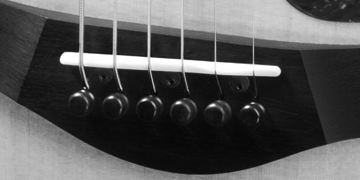
The three ES-2 pickup sensors sit behind the saddle with hex adjustment screws visible between the saddle and bridge pins.
Understanding What Makes the ES-2 Different
Before we dive into what to inspect, it helps to understand why the ES-2 works the way it does. Unlike traditional under-saddle piezo pickups that sit beneath the saddle, the ES-2 uses three individual pickup sensors positioned behind the saddle. Each sensor presses against the back of the saddle and detects its pendulum-like motion as you play. This design captures a more natural, dynamic acoustic tone compared to the often “quacky” sound of traditional under-saddle systems.
The key components you’re evaluating on a used Taylor with ES-2 include: the three pickup sensors and their adjustment screws, the preamp controls on the upper bout, the battery compartment and connections, and the overall wiring integrity.
The Critical Inspection Points
1. Check the Pickup Adjustment Screws
This is where I always start. Look at the bridge—you should see three small hex screws (requiring a 0.050″ Allen wrench) positioned between the saddle and the bridge pins. These screws control how much pressure each sensor applies to the saddle. Here’s what to look for:
The screws should be present and not stripped. I’ve seen guitars where someone used the wrong tool and damaged the hex heads. The pickup housings should sit roughly flush with the top of the bridge—if they’re sitting too low or appear pushed down, someone may have improperly removed the saddle without loosening the screws first, potentially damaging the sensors.
Pro Tip: Always loosen these three screws 1-1.5 turns before removing the saddle on any ES-2 equipped guitar. Failing to do this can damage the pickup sensors—and this is one of the most common causes of ES-2 problems on used guitars.
2. Plug In and Test String Balance
Bring a small acoustic amp or use headphones with an interface. Plug in the guitar and play each string individually, then in pairs. The ES-2 adjusts output in string pairs (E/A, D/G, B/e), so listen for:
Are any strings noticeably louder or quieter than others? Does the low E string sound thin while the high strings are booming? Unbalanced output is usually fixable by adjusting the hex screws, but severe imbalance might indicate a damaged sensor—especially if adjustments don’t help.
3. Listen for the Common Problems
During your plug-in test, specifically listen for:
Excessive string noise: The ES-2 is known for being sensitive to finger squeaks and string noise. Some sensitivity is normal, but if it’s overwhelming even with a light touch, the sensors may be over-tightened or there could be an underlying issue.
Buzzing or humming: This often indicates a grounding problem. Check that the ground wire (visible inside the soundhole, connecting to the bridge plate) is securely attached. A loose ground wire is a common fix, but a damaged one is more involved.
Intermittent signal or dead output: Try wiggling the cable at the output jack. If the signal cuts in and out, the jack may need cleaning or replacement. Also check for any sound when you turn up the treble—if you hear hiss through the amp but no guitar signal, you may have a dead pickup sensor. The ES-2 sensors are wired in series, so one dead sensor kills the whole system.
4. Inspect the Preamp Controls
The ES-2 features three controls on the upper bout: volume, treble, and bass. Rotate each knob through its full range while plugged in. Listen for scratchy sounds or dropouts, which indicate dirty or worn potentiometers. These are fixable but factor the repair cost into your offer.
5. Check the Battery Compartment
The ES-2 uses a single 9-volt battery housed in a compartment at the tail end of the guitar. Open it up and look for:
Corrosion on the battery contacts is a red flag—it suggests the guitar was stored with a dead battery for an extended period. Clean contacts can often be restored, but severe corrosion may have damaged the wiring. Also verify the battery clip mechanism works properly and holds the battery securely.
Pro Tip: If the amplified tone sounds distorted even with all EQ settings flat, try a fresh battery first. A weak battery is the most common cause of ES-2 tone problems and the easiest fix.
6. Look Inside the Soundhole
Using a flashlight or your phone, look inside the soundhole at the preamp circuit board (mounted on the treble side, aligned with the control knobs). You should see an LED that indicates battery life—it should light up when a cable is plugged in. If you can, check that all visible wiring connections appear secure and undamaged.
Pros and Cons of the Taylor ES-2
| Pros | Cons |
|---|---|
| More natural, dynamic acoustic tone compared to traditional under-saddle pickups | Can be overly sensitive to string noise and finger squeaks |
| Adjustable output for each string pair allows fine-tuning balance | Proprietary system—only designed for Taylor guitars |
| Eliminates the “thin” or “quacky” piezo tone common with UST pickups | Pickup sensors can be damaged if saddle is removed improperly |
| Simple, intuitive onboard controls (volume, treble, bass) | Difficult and expensive to replace with aftermarket systems if desired |
| Excellent feedback resistance for live performance | Sensors wired in series—one dead sensor kills entire system |
| Battery life indicator LED on preamp board | Some players find the high-end can sound harsh through certain amps |
| Forgiving of less-than-perfect saddle fit compared to UST systems | Repairs typically require Taylor-authorized service for best results |
Red Flags That Should Lower Your Offer
Based on my experience, here are issues that warrant negotiating a lower price or walking away entirely:
Stripped adjustment screws: These are small, specialized screws. If they’re damaged, balancing the pickup becomes difficult or impossible without replacement parts.
Previous saddle replacement with non-factory parts: The ES-2 is calibrated for Taylor’s saddle dimensions. Aftermarket saddles may not contact the sensors properly.
Signs of internal modification: If someone has attempted to install a different pickup system or modified the wiring, proceed with extreme caution. The ES-2’s installation creates permanent holes in the bridge that make reverting or changing systems complicated.
Corroded battery compartment: While surface corrosion is cleanable, heavy green buildup may have traveled into the wiring.
Quick Pre-Purchase Checklist
- ☐ Three hex screws visible and undamaged between saddle and bridge pins
- ☐ Pickup housings flush with bridge surface
- ☐ Clean battery compartment with working clip
- ☐ All three controls (volume, treble, bass) rotate smoothly without scratching
- ☐ Signal present when plugged in with fresh battery
- ☐ Balanced output across all strings
- ☐ No excessive buzz or hum (ground wire intact)
- ☐ LED lights up on preamp when cable inserted
- ☐ Original Taylor saddle in place
- ☐ No signs of attempted pickup replacement or modification
Final Thoughts
The Taylor ES-2 is a legitimately great pickup system when it’s functioning properly. I’ve owned several Taylor acoustics with this system, and they consistently deliver one of the most natural amplified acoustic tones available from an onboard pickup. The key is making sure you’re buying one that’s been properly maintained.
Take your time during inspection, bring an amp if at all possible, and don’t be afraid to ask the seller about the guitar’s history—specifically whether the saddle has ever been removed and if the electronics have had any work done. A well-maintained ES-2 equipped Taylor can serve you for decades on stage and in the studio.
Have questions about a specific Taylor you’re considering? Drop us a line—we’re always happy to help fellow players find the right guitar.